
don't wait, call now!
adventures in compilation albums

Remember those 90s-era commercials for the International Correspondence School? No one in my family had gone to college. Lacking any context for higher education, I’d listen to Sally Struthers list off the “exciting career choices” I could pursue with a degree from home and I honest to god thought that was college. I was in kindergarten and weighing the pros and cons of being a bookkeeper versus VCR repairwoman.
Those commercials and others shaped my adolescent fantasy of adulthood. The glow of the screen was my reference point and there was little to correct misunderstandings. I’d imagine myself, an ICS degree hanging proudly on my wall and my hair bouncy from Herbal Essences shampoo (the pink one, specifically). I’d invite friends over for a slice of Viennetta cake and we’d linger over a cup of General Foods International Coffee while I shared charming anecdotes about my husband (David Duchovny) and then, much to my friends’ admiration and delight, I’d pop in a copy of Pure Moods.
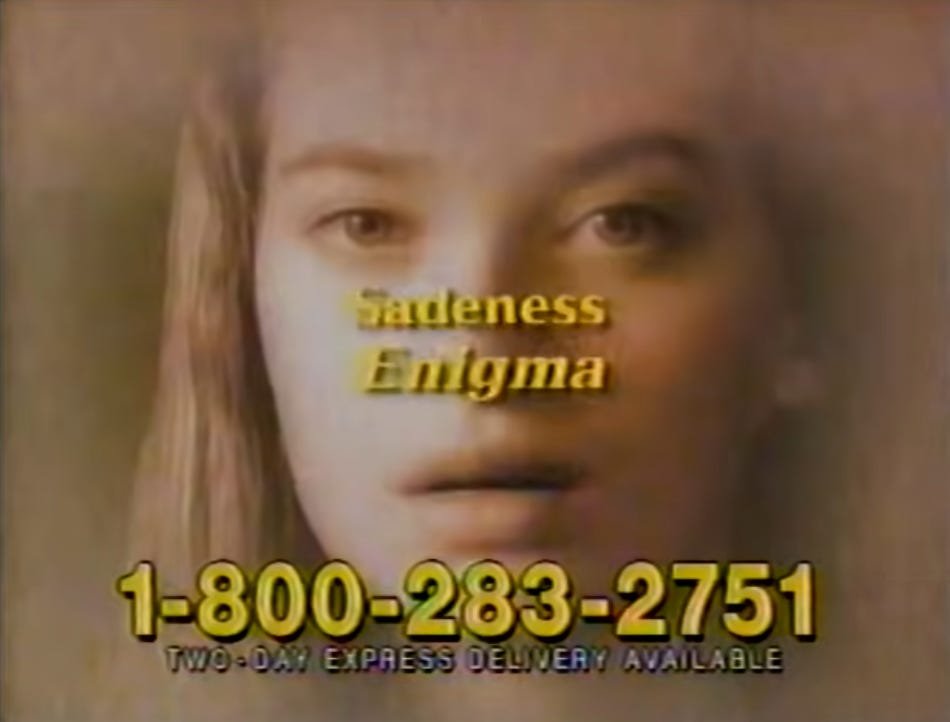
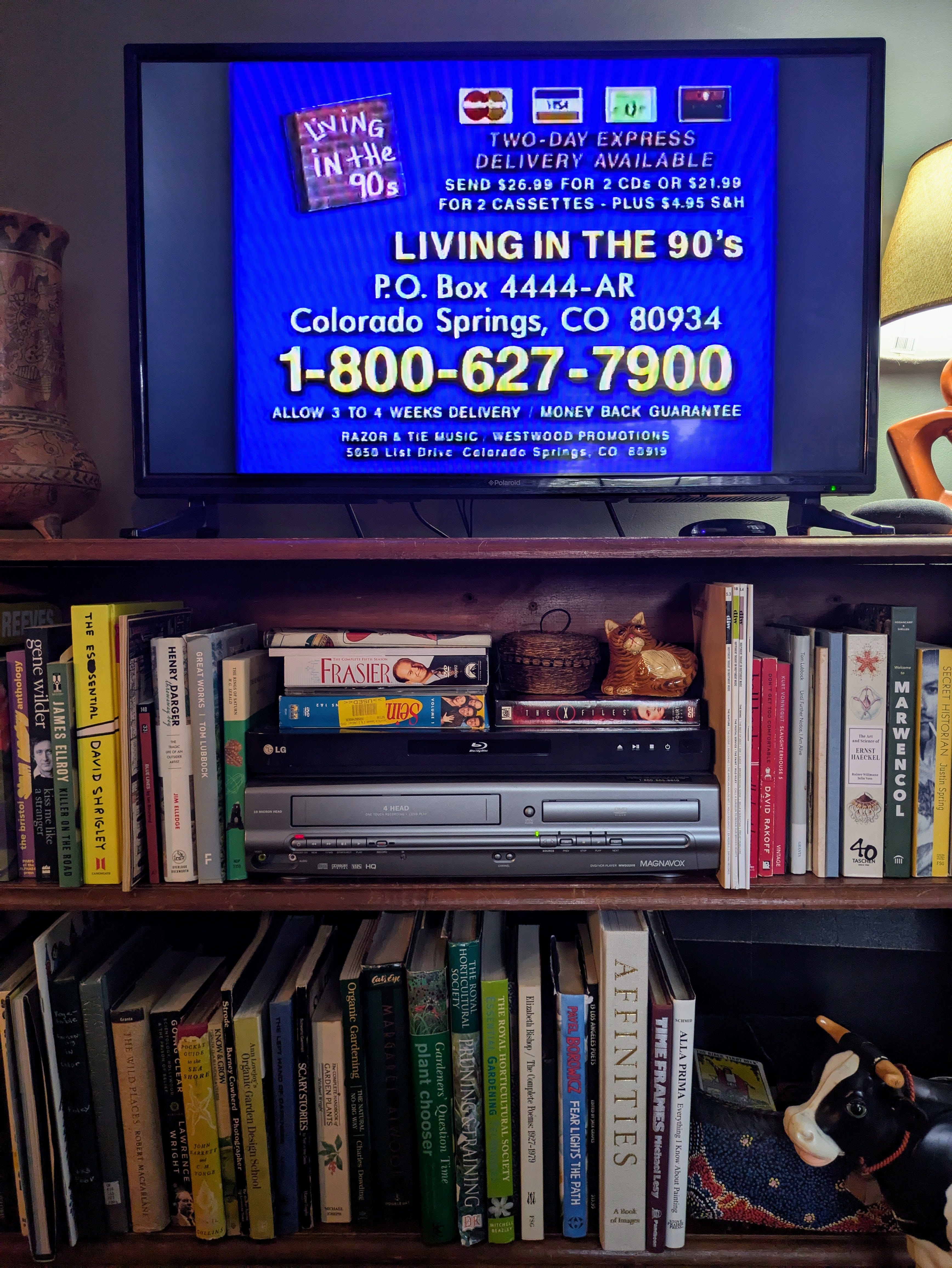
If you watched TV in the 90s and early 2000s, the mere mention of Pure Moods probably sends you spiraling into flashbacks of Enya serenading you awake at 3:00 AM. An entire genre of compilation album commercials were a mainstay of the era’s viewing experience. “Imagine owning the world’s greatest love songs,” one temptingly promised with images of sunset-lit silhouettes caressing each other on the beach. “Imagine a world where time drifts slowly,” the soothing Pure Moods voice purred over songs “direct from Europe.” As a child, these albums felt like a ticket to an entirely new and sublime plane of existence via express delivery if you paid extra.
I’d even watch the extended infomercial versions. I was transfixed by scrolling song titles floating across the screen and the overwrought sales pitches. Along with water beds, trampolines, and name brand cereal, compilation albums conveyed a sense of put-togetherness and a middle class lifestyle that felt out of reach from my rural upbringing. Owning a Time Life compilation album meant you had disposable income and access to a credit card. They signified to my child mind both an advanced level of taste and financial security all for the low low price of $39.95 $19.95 if you call now!

Some aspects of my childhood fantasy were eventually corrected by time and experience. I realized the unlikelihood of marrying David Duchovny and by middle school, I’d been whisked into a special program for low-income students that ferried us around to college campuses. I realized there actually were more than degrees in “learning the personal computer.” But I’m still fascinated by compilation albums - it’s only the content that’s changed. Less Pure Moods, and more Strum & Thrum: The American Jangle Underground, 1983-1987.
Personally, I feel the compilation album is unfairly maligned but also I tend to have a chip on my shoulder about things like this so I’m probably wrong and everyone actually loves them and doesn’t immediately associate the genre with late night television. I only found one article that touched on the history of compilation albums from an academic perspective and it was an ungenerous take:
The success of compact disc technology was an important lesson for the music industry. It showed that, in order to stimulate record sales, it is not necessary to develop new talents and songs—sales can also be generated by releasing and promoting old sounds in a new wrapping. In other words, the risk associated with new product development can be lowered by spending the product development effort and monies on re-packaging old and proven songs.1
While that certainly rings true of the compilation albums advertised on late night TV, it doesn’t describe the ones I listened to for this week’s post. Compilation albums are by definition collections, and there’s a lot of wiggle room within that concept. Many of this week’s selections felt like celebratory labors of love, not repackaged garbage.
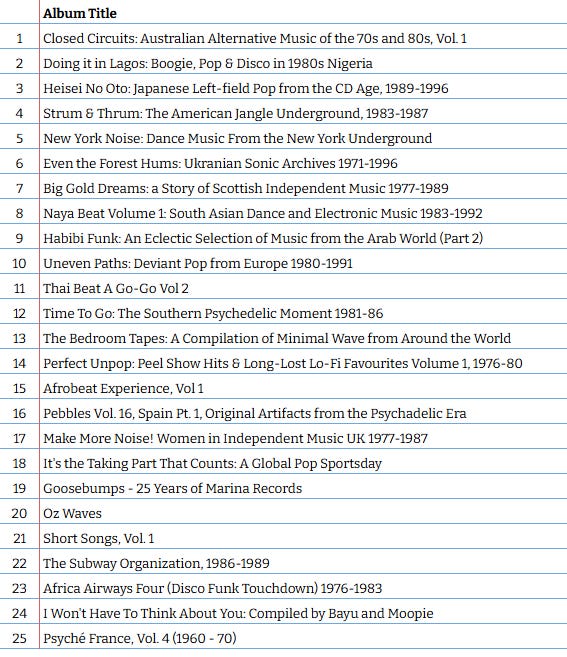
This week’s playlist on Spotify or Apple Music
If you spoke to me two weeks ago, I would have bragged that I was going to listen to 40 different compilations before writing this post. Then it was 30 before ultimately being whittled down to 25. I had not anticipated the mental exhaustion of back-to-back compilation album consumption and jolting myself from one genre, geographic region, record label, or theme to another throughout a single workday. I also seem to have forgotten that compilation albums are often really fucking long.
But nestled within each of the 25 compilation albums I listened or re-listened to, there’s been great songs I’d never heard or ones I’d criminally overlooked when listening the first time through. The thrill of a good compilation album is this kind of accidental discovery.
That starts with “Not To Take Sides” by Sneaky Feelings from Time to Go - The Southern Psychedelic Movement 1981-1986. I was shocked I’d never heard this song. If you took all aspects of my musical tastes and threw them into a blender, 10/10 times you’ll get a jangly indie song with a great chorus. “Not To Take Sides” is such a dictionary-definition example of the kind of song I dearly love.
Also very on brand for me is Make More Noise! Women in Independent Music UK 1977-1987. This was a re-listen but I had completely forgotten just how many good tracks are peppered throughout its sprawling 3 hour running time. “Plastic Flowers” by Devil’s Dykes and “Bored Housewives” by Androids of Mu are both standouts. I was also pleasantly surprised that “Small Town Girl” by Tracey Thorn is on there - it’s one of my top ten favorite songs of all time. While I settled on “It Makes Me Realise” by the Go! Service for this playlist, I could have blindly thrown a dart at this album and hit a great song.
Another re-listen was the Habibi Funk compilation. “Haditouni” by Douaa is effortlessly cool - the definition of sultry. I woke up at 2:00 AM the other night with this song bouncing around in my head. But I’m also pleading for you to listen to “Badala Zamana” by Zohra. I already included it on a dance/disco playlist earlier this year and since I’ve got some self-imposed rule about including the same song twice, this is my way of sneaking it in for a second time. It triggers me into dance-mode. I’ve got to be careful listening to this song at work lest someone walk in and witness me in my cubicle, cocooned in my heating blanket, and bobbing up and down like I’ve finally cracked under the weight of my spreadsheets. The whole Habibi Funk compilation is excellent, but those two tracks deserve your time and ears.
We’ve now strayed pretty far from Pure Moods. I watched the commercial while writing this post and it’s much cornier than I remember (but also kind of iconic, in a 90s sort of way). I don’t recall actually liking any of those songs when I saw the commercial as a child. I didn’t go beg my parents for an Enya album. But in rewatching it, I was reminded of how exciting it must have felt glimpsing the vastness of music and realizing there were so many songs beyond my seven year old comprehension. A little tingle of possibility. That’s not dissimilar to the feeling I’ve had listening to these compilation albums over the past week and a half.
Listening to as many compilations as I could stand was a slog, but it also rewarded me handsomely. My ears are sore from my headphones but my mind is buzzing with the special thrill of hearing (or rediscovering) songs I know I’ll return to. Consuming music can often feel stagnant when you’re stuck in your own self-induced musical rut but compilation albums are a wonderfully noisy antidote. It’s like hitting a reset button on your listening habits. Not a bad use of my time, if you ask me.
…so…should I listen to Pure Moods or not?
I can’t believe I’ve forgotten to post a link to this lately, but, here’s absolutely everything I’ve put onto a playlist this year tidily organized onto one mega-playlist.
Wikström, Patrik, and Robert Burnett. “Same Songs, Different Wrapping: The Rise of the Compilation Album.” Popular music and society 32.4 (2009): 507–522.